Data Wrangling Pipeline
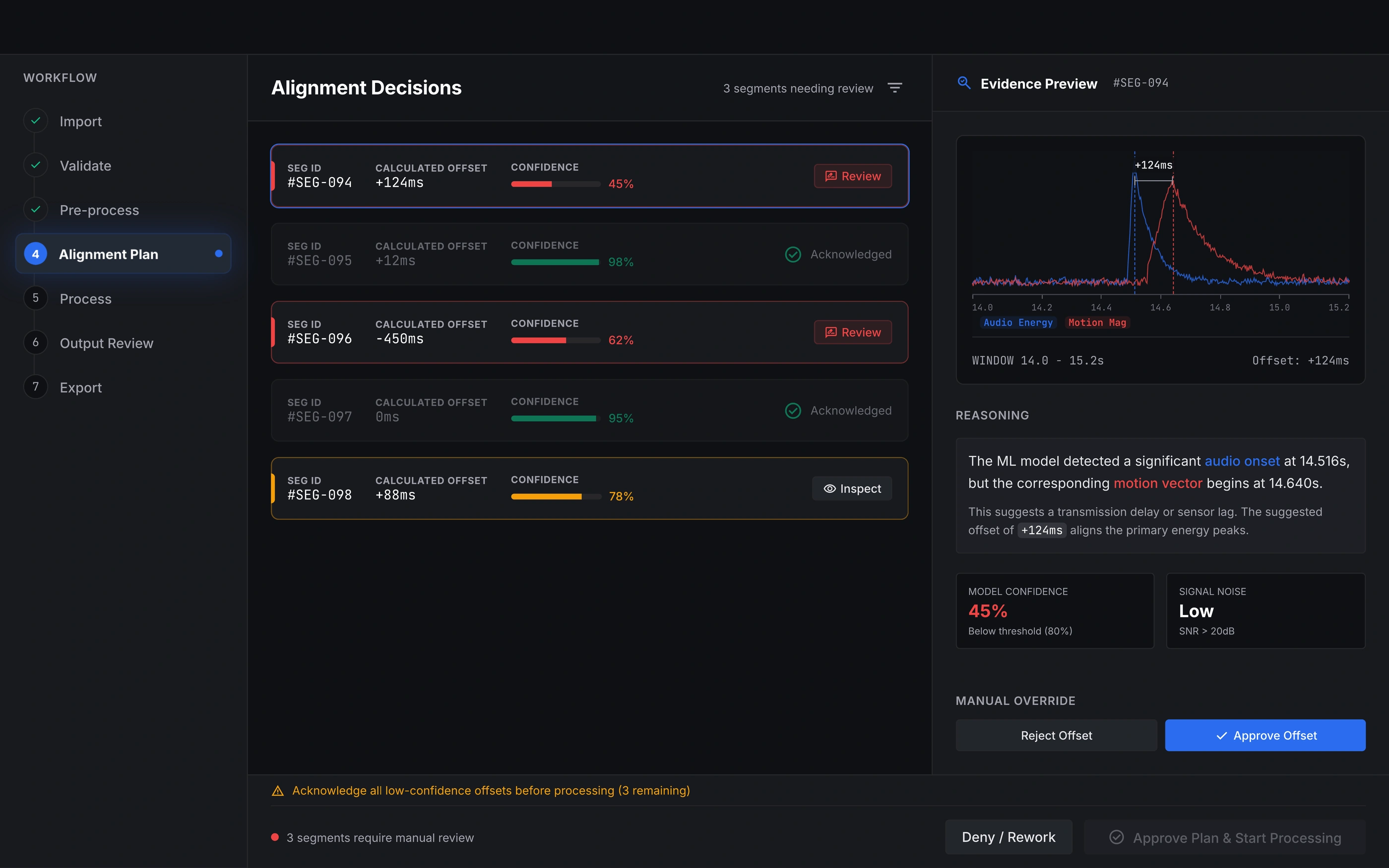
Designed and prototyped a data-wrangling application implementing a guided seven-step import-to-export pipeline for time-series motion-sensor and audio data, with human sign-off gates on every high-risk transformation. Prototyped the alignment-approval gate first, because that was the decision the rest of the product depended on.
The hard problem was drawing the boundary between what automation should do and what a human must approve. Early versions conflated validation with alignment, which made the workflow untrustworthy: a user could not tell whether an anomaly was real signal or an artifact of bad preprocessing. I separated the pipeline into deterministic stages (validate, pre-process) and judgment stages (alignment plan, review), and made the ML-proposed cross-stream alignment a proposal, never an action. Every proposed offset carries a confidence score, the method used, and its supporting evidence, behind an explicit approval gate, and flagged segments hard-block export. The rationale is that for high-stakes data transformation, an AI product earns trust through explainability and reversibility rather than accuracy claims.
Built
- Seven-step pipeline: Import, Validate, Pre-process, Alignment Plan, Process, Review, Export, with written decision rationale for each stage boundary.
- Stack: React, Vite, Tailwind, PostgreSQL, with an ML alignment step proposing cross-stream offsets.
- Guardrail architecture: explicit sign-off gates, flagged-segment hard stops before export, audit trails across the input-to-output lifecycle, anonymization before any downstream AI interaction.
- Human-in-the-loop AI: ML-proposed alignment paired with confidence scoring and evidence, keeping privacy and human oversight first-class.